Horticulture & Care
[ planting · soil · water · pruning · division · powdery mildew ]
Site selection & planting
Plant in fall (best for Tulsa — cool soil, winter rain to
establish roots) or in early spring. Choose the
sunniest, driest, leanest spot you have: full sun (6+ hrs),
average to dry well-drained soil, with good air circulation.
Wild bergamot tolerates clay, rocky, and alkaline soils as long as drainage is
adequate. Avoid rich, heavily mulched, frequently irrigated borders
— soft, lush growth flops and is far more susceptible to powdery mildew.
- Spacing: 18–24" between plants for airflow.
- Hole: match the rootball; do not amend the planting hole.
- Mulch: a thin (1") layer of pine straw or gravel; keep mulch off the crown.
- Water: deeply once a week the first season, then on rainfall.
- Fertilizer: none. Extra nitrogen produces tall, weak, mildewed stems.
Powdery mildew — the one real problem
In Oklahoma's humid summers, Erysiphe and Golovinomyces powdery
mildew can coat lower leaves with white powder by mid-July. Susceptibility is
highly genetic: wild seed-strain plants vary widely, and cultivar
choice matters enormously. Cultural controls that actually work:
- Plant a mildew-resistant cultivar (see table below).
- Full sun & airflow — do not crowd; do not plant against a fence with no breeze.
- Lean soil, no irrigation after establishment — bergamot is happiest a little stressed.
- Cut back hard after main bloom (see below) to flush clean foliage.
- Remove and destroy heavily infected stems at season's end — do not compost.
Pruning & cut-back
Cut every stem to 4–6" immediately after the main bloom
finishes (typically late August in Tulsa). This single step does three things:
removes mildewed foliage, encourages a clean fresh basal flush for fall, and on
many plants triggers a light second bloom in September. Leave
the final autumn growth standing through winter for seedheads, structure, and
overwintering insect habitat; cut to the ground in late February before new
growth resumes.
Division & propagation
-
Division (most common): Lift clumps in early spring as new
shoots emerge; the center of an old clump dies out and divides easily into
4–6 vigorous outer pieces. Divide every 3–4 years
to keep plants vigorous and floriferous.
-
Seed: Easy. Surface-sow on moist mix in fall and overwinter
outdoors (cold stratification ~30 days), or refrigerate moist for 4–6
weeks and sow in spring. Light-dependent germinator — do not bury seed.
Wild seed strains will be variable for mildew resistance.
-
Cuttings: Softwood tip cuttings in late spring root readily
in 10–14 days under a humidity dome; this is the standard way named
cultivars are propagated.
Notable cultivars for NE Oklahoma
| Cultivar |
Species / parentage |
Distinguishing feature |
Notes for Tulsa |
| 'Claire Grace' |
M. fistulosa |
Strong lavender-pink flowers; excellent powdery-mildew resistance |
The standout straight-species selection for Oklahoma. Hardy, xeric, butterfly magnet. |
| 'Marshall's Delight' |
M. didyma hybrid |
Bright pink, mildew-resistant, ~36" |
Wants a touch more moisture than straight fistulosa; afternoon shade helps. |
| 'Jacob Cline' |
M. didyma |
Tall (~48") deep scarlet-red flowers; very mildew-resistant |
The hummingbird cultivar. Needs steadier moisture than fistulosa; plant in part shade in OK. |
| 'Raspberry Wine' |
M. didyma hybrid |
Wine-red flowers, ~36", good resistance |
Bold border color; treat as didyma — medium moisture. |
| 'Petite Delight' |
M. fistulosa hybrid |
Compact (~15"), lavender-pink, very mildew-resistant |
Excellent for small pollinator beds and the front of borders. |
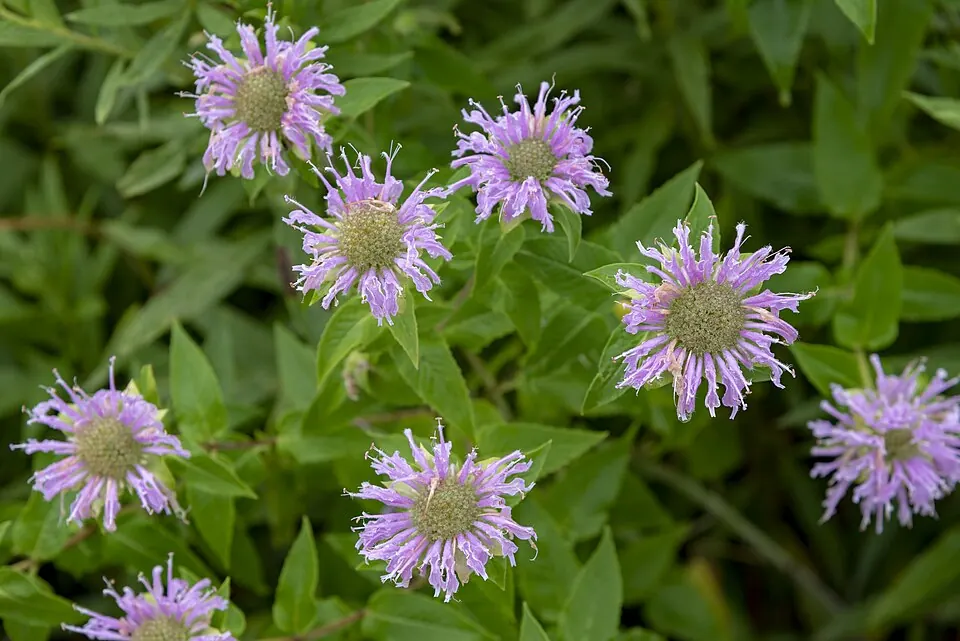
Tulsa cultivar pick: If you want one mildew-resistant Monarda for
an Oklahoma prairie-style planting, choose 'Claire Grace'. It is
a selection of straight M. fistulosa, so it keeps the species'
xeric tolerance and pollinator value, while shrugging off the humid-summer mildew
that flattens average wild seed strains. Then cut it hard after bloom
for clean fall foliage.
Companion planting in a prairie / pollinator garden
Pairs naturally with: butterfly milkweed (Asclepias
tuberosa), black-eyed Susan (Rudbeckia hirta),
purple coneflower (Echinacea purpurea),
little bluestem (Schizachyrium scoparium),
indiangrass (Sorghastrum nutans),
blazing star (Liatris spp.) and
aromatic aster (Symphyotrichum oblongifolium) for an
uninterrupted June–October bloom sequence under the dappled shade of an
eastern redbud.


.jpg)