Horticulture & Care
[ planting · soil · water · pinching · cultivars · pests ]
Site selection & planting
Plant in spring or early fall from 1-quart or 1-gallon nursery
stock. Choose the sunniest, leanest, most well-drained spot you have
— full sun (6+ hrs) gives tighter form and far heavier bloom; afternoon shade
produces a floppy, sparse-flowering plant. Soils should be on the rocky, sandy or
thin-clay end of the spectrum; aromatic aster fails in heavy, wet, or
high-fertility ground. Do not amend the planting hole with compost.
- Hole: twice the rootball width, same depth.
- Backfill: native soil only — richer is worse, not better.
- Mulch: a thin (~1") gravel or pea-stone mulch is ideal; avoid thick wood-chip mulches that hold moisture against the crown.
- Water: deeply 1×/week the first summer, then on rainfall.
- Spacing: 24–30" on center; the woody crown widens visibly each year.
The pinching technique (most important step)
Without pinching, even the best cultivars get tall and floppy by bloom time. The
standard regimen is to pinch back twice: cut all stems back by
roughly 1/3 in mid-May, then again in late June.
This forces compact branching, doubles the number of flower-bearing tips, and
produces the dense mounded form the plant is famous for. Stop pinching by
July 4 — later cuts will delay or eliminate fall bloom.
Water & soil after establishment
Once established (after the first full growing season), aromatic aster is one of
the most drought-tolerant perennials available for the southern
plains. Supplemental water is rarely needed and is in fact counterproductive
— over-watered plants flop, bloom less, and short-circuit the species'
evolved survival strategy.
Cultivars (and the Mt Cuba trial)
| Cultivar |
Size |
Distinguishing feature |
Notes for Tulsa |
| 'October Skies' |
18–24" × 30–36" |
Compact dome, sky-blue flowers, exceptionally heavy bloom |
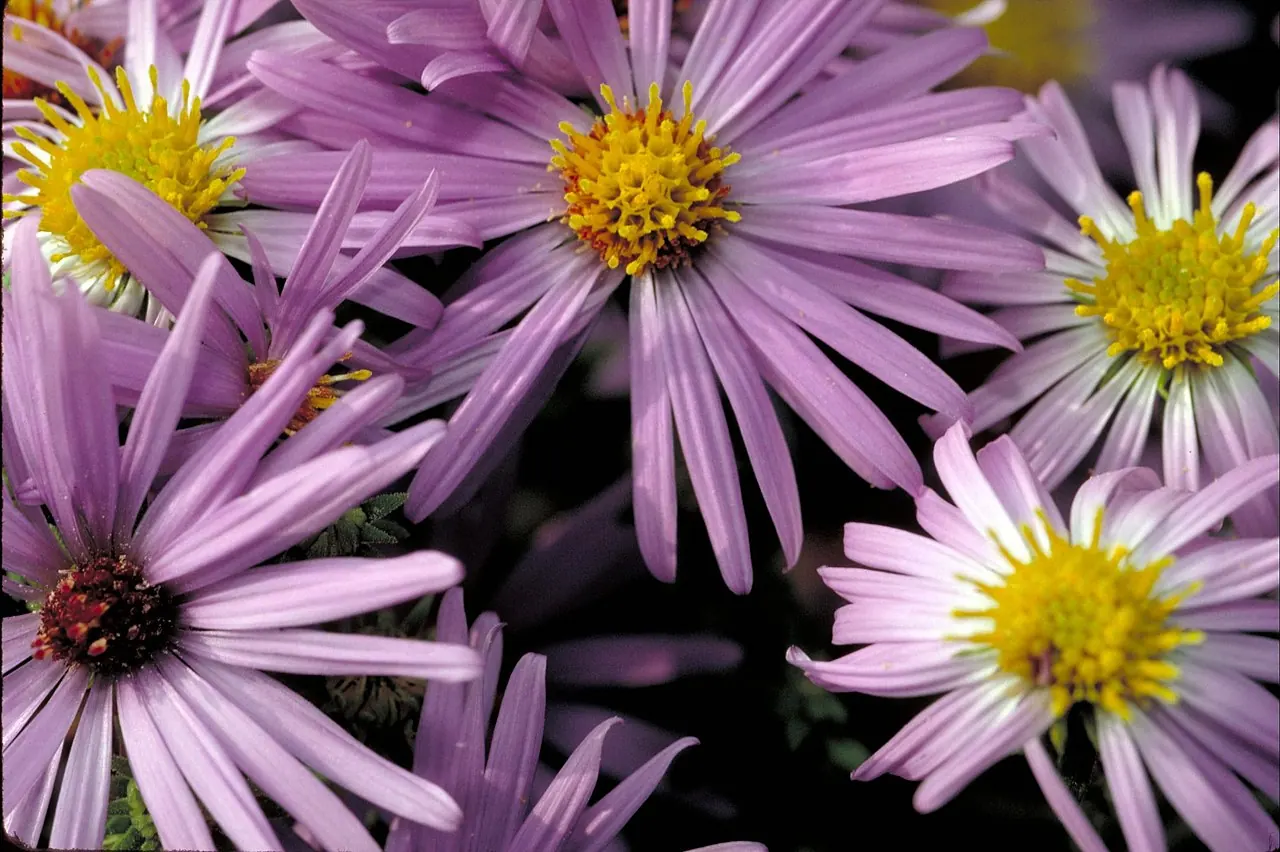
Top performer in Mt Cuba Center's 2012–2014 aster trial; the gold-standard selection for small gardens. |
| 'Raydon's Favorite' |
24–36" × 30–36" |
Slightly taller, larger lavender-blue flowers, very strong stems |
Also a Mt Cuba trial top performer; better choice where a bit more height is wanted. |
| 'Dream of Beauty' |
10–18" × 24–30" |
Soft pink rays with yellow disk; very low mound |
The classic pink-flowered selection; pairs well with the blue cultivars for color contrast. |
| Straight species |
2–3 ft × 2–3 ft |
Looser habit, more variation, true ecotype value |
Best choice for prairie restorations or any planting where seed-grown genetic diversity matters more than uniform bloom. |
Mt Cuba Center Aster Trial (2012–2014): The trial that
essentially settled the question of which aromatic asters to plant.
'October Skies' and 'Raydon's Favorite' were both
named top performers, scoring near the top of the entire 70-cultivar field for
habit, disease resistance, bloom duration, and pollinator visitation. If you
buy only one aromatic aster for a Tulsa garden, choose one of these two.
Pests & diseases
- Powdery mildew & rust — the chronic problem of New England aster (S. novae-angliae) is largely absent from aromatic aster, which is one reason it scored so well in the Mt Cuba trial.
- Aphids & lace bugs — cosmetic only; controlled by lady beetles and lacewings.
- Deer & rabbit — the aromatic foliage is largely ignored by both. As close to deer-proof as a flowering perennial gets in this region.
- Crown rot — the only real killer; caused by wet, heavy, poorly-drained soil. Cure by moving the plant.
Companion planting in a Tulsa prairie garden
Plant in drifts of 5–9 with little bluestem
(Schizachyrium scoparium) for the warm copper-orange backdrop the
lavender flowers play against, and behind Maximilian sunflower
(Helianthus maximiliani), which blooms a few weeks earlier and creates a
late-summer-into-fall sunflower-then-aster sequence that is genuinely magical
on the southern plains. Other strong partners: prairie dropseed, butterfly weed,
purple coneflower, rough blazing star, goldenrods (especially Solidago
speciosa), and any of the warm-season bunchgrasses.