home/ plants/ pawpaw

// SPECIES PROFILE · TREE · NATIVE

Pawpaw

Asimina triloba

The largest edible fruit native to the United States — and a temperate outlier in the otherwise tropical custard-apple family (Annonaceae), shared with cherimoya, soursop and sweetsop. Pawpaw is a clonal understory tree of bottomland forests whose huge, drooping, drip-tipped leaves look distinctly out of place in NE Oklahoma — until you remember it's the closest temperate relative of a rainforest family. Its maroon, downward-facing flowers are pollinated by flies and tiny sap beetles, not bees, and its leaves are the sole larval food of the zebra swallowtail butterfly (Eurytides marcellus). Tulsa sits at the western edge of the pawpaw's native range, where wild patches still persist in Ozark fringe woods and along the Verdigris, Illinois and Caney river bottoms.

// QUICK FACTS
Family
Annonaceae (custard-apple family)
Order
Magnoliales (basal angiosperm / magnoliid clade)
Native range
E. North America: S. Ontario → N. Florida, west to E. Nebraska & E. Texas
USDA hardiness
Zones 5–9 (Tulsa = 7a/7b — well within range)
Mature size
15–30 ft tall · 15–20 ft spread (clonal patches wider)
Growth rate
Slow first 2–3 yrs, then moderate; first fruit 5–8 yrs from seed
Bloom
Late March – mid April (NE OK), before leaf-out
Flower
Maroon, 6 petals in 2 whorls, 1–2", faint fetid/yeasty scent
Fruit
Yellow-green oblong berry, 3–6", 3–18 oz; ripens late Aug–early Oct
Sun
Seedlings: shade required · Established: full sun → part shade
Soil
Deep, fertile, moist but well-drained; slightly acidic (pH 5.5–7.0)
Water
Medium-high; intolerant of drought when young, of standing water always
Pollination
Self-incompatible — 2 unrelated trees required for fruit
Wildlife
Zebra swallowtail (sole host) · pawpaw sphinx · raccoons, foxes, opossums
Pawpaw (Asimina triloba) — small understory tree with large drooping ovate leaves
Asimina triloba in summer foliage — the unmistakable drooping, tropical-looking leaves of America's largest native fruit tree. Photo: Rooted Revival field documentation, NE Oklahoma.

Identification

[ field key — bark · leaf · flower · fruit · habit ]

Habit & Bark

Small deciduous tree, typically 15–30 ft, occasionally to 45 ft in old bottomland stands; usually encountered as a clonal patch of many vertical stems connected by shallow rhizomes. Trunks are slender, 8–12 in diameter at most. Bark is thin, smooth, light gray often blotched with paler gray, and develops shallow fissures with age. Crushed bark and twigs smell strongly disagreeable — an immediate confirmation of identity. Branchlets are slender, light brown tinged red, with two kinds of winter buds: pointed, appressed leaf buds and round, fuzzy brown flower buds.

Leaves

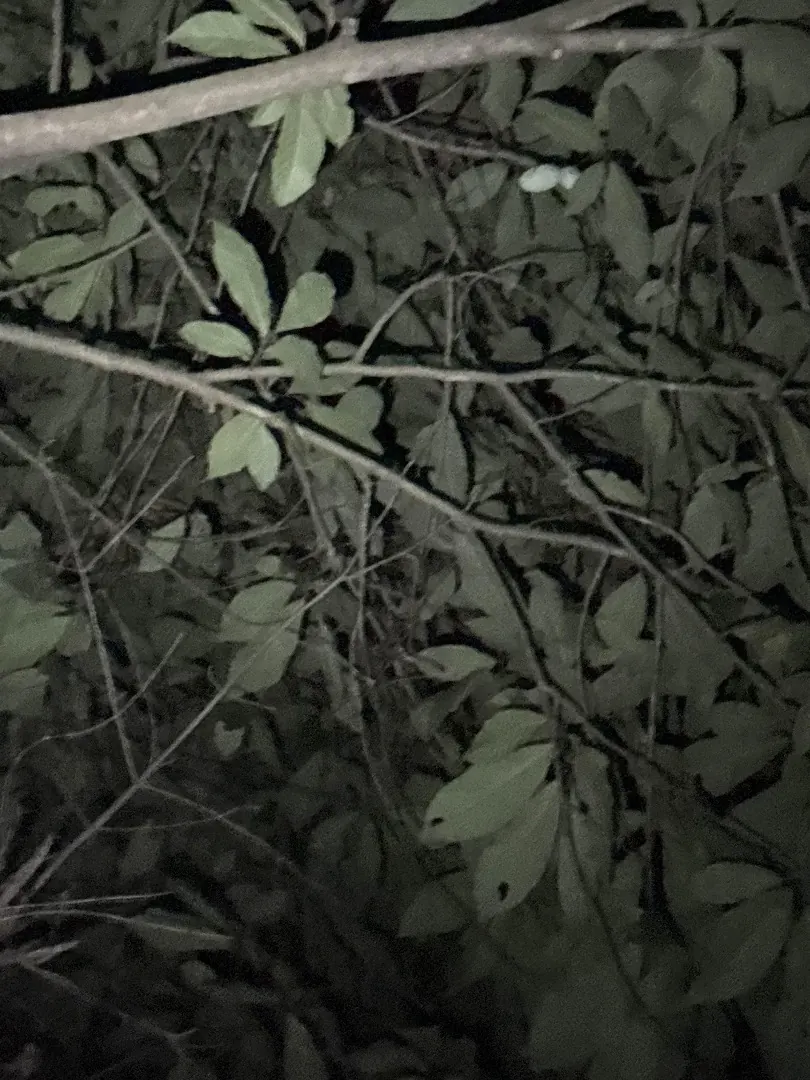
Alternate, simple, entire, obovate-lanceolate, 10–12 in long and 4–5 in wide — among the largest simple leaves of any temperate North American tree. Wedge-shaped at the base with an acute apex and a faint "drip tip," a feature far more typical of tropical rainforest plants. Clustered symmetrically toward branch tips, giving foliage a distinctive shingled, imbricated look that droops in the heat. Dark green above, paler beneath; bruised leaves smell of green bell pepper. Turn rusty yellow in October — pawpaw patches are visible from a quarter mile in fall.

Flowers

Solitary, nodding (downward-facing), borne on stout hairy peduncles in the axils of last year's leaves. 3 sepals, 6 petals in two whorls of three — outer petals broad and reflexed, inner petals smaller, erect, and nectar-bearing. Buds open green, age through brown, and finally turn a deep maroon / wine-purple 1–2" across at maturity. Open in early spring (late March in Tulsa), well before leaves emerge. Carry a faintly fetid, yeasty scent and elevated temperature — classic signatures of fly and beetle pollination, not bee pollination. Flowers are protogynous: the stigma is receptive several days before the same flower's pollen is shed, enforcing outcrossing.

Fruit & Seeds

A large fleshy berry — botanically a single fruit, not a pod — 3–6 in long, 1–3 in wide, and up to 18 oz. Borne singly or in small clusters that bend the weak branches downward. Skin remains green to yellow-green even when ripe, sometimes blotched brown (a relict adaptation to ice-age megafaunal dispersal — color is no use to a mammoth that finds fruit by smell). Flesh is soft, yellow to orange, custard-textured, and aromatic of banana, mango and pineapple. Each fruit contains 6–14 large flat lima-bean-shaped brown seeds, 1/2–1 in long, embedded in the pulp. Ripens in NE OK from late August through early October; ripe fruit drop unaided.

Habitat & Range in NE Oklahoma

Pawpaw reaches the western edge of its native range in eastern Oklahoma. Wild populations are documented along the Verdigris, Illinois, Caney and Neosho river bottoms, in shaded ravines of the Ozark Highlands fringe in Cherokee, Adair, Delaware and Mayes counties, and in scattered seeps and creek-bottoms across the Cookson Hills. It does not naturally extend west into the central Cross Timbers or onto the Plains; west of roughly Tulsa, summers are too dry and soils too thin for unirrigated wild patches.

Within its preferred sites, pawpaw is a clonal understory tree of deep, fertile, moist but well-drained alluvial soils. It tolerates remarkable shade — the species is among the most shade-adapted woody plants in eastern North America — and forms dense, self-perpetuating patches by sending out shallow horizontal rhizomes. Because all the stems in a patch are usually genetically identical clones, large wild patches frequently produce no fruit at all: pawpaw is self-incompatible and needs pollen from a second, genetically distinct plant.

For Tulsa-region growers (USDA zones 7a/7b), pawpaw is firmly within its cultivated range. Provide deep soil, summer irrigation in the first 2–3 years, and shade for the seedling stage; after that it thrives.

Ecology & Wildlife Value

[ pollinators · larval hosts · seed dispersal · trophic role ]

Pollination — Flies & Beetles, Not Bees

Pawpaw flowers display a carrion-fly / beetle pollination syndrome: maroon color, downward-facing orientation, faint fermented or fetid scent, low-mounted nectar-rich petal bases, and thermogenic warming. Confirmed visitors include Glischrochilus quadrisignatus and Stelidota geminata (small sap beetles, family Nitidulidae) and various blow flies and flesh flies. Bees ignore the flowers entirely. Because these pollinators are weak fliers with short ranges and require rotting fruit and leaf litter on the ground for their larval stage, an isolated yard tree with a tidy mulch ring may set very little fruit.

Hand Pollination in Cultivation

Many serious pawpaw growers hand-pollinate for reliable fruit set: collect pollen from a flower in male-stage (anthers shedding, pollen dusty) on one tree using a small artist's brush, then dab it onto the receptive stigmas of female-stage flowers (stigmas glossy, petals just opening) on a different, unrelated tree. Some growers also hang strips of meat or spray fish emulsion in flowering pawpaws to attract more carrion flies — effective but neighborhood-controversial.

Zebra Swallowtail — Sole Host

The zebra swallowtail butterfly (Eurytides marcellus) lays its eggs only on young pawpaw leaves; throughout most of its range, no other host plant is used. Caterpillars sequester annonaceous acetogenins from the foliage, making both larvae and adults unpalatable to birds. Where pawpaw is absent, the zebra swallowtail is absent. Planting a pawpaw thicket in NE Oklahoma is a direct, measurable contribution to the regional population of one of North America's most striking native butterflies. The pawpaw sphinx moth (Dolba hyloeus) and the asimina webworm (Omphalocera munroei) also feed on pawpaw leaves.

Seed Dispersal & Mammals

Pawpaw fruit is an evolutionary anachronism: too large, too soft, too seedy, and too aromatic to be efficiently dispersed by any extant North American animal. Its true partners — mastodons, mammoths, and giant ground sloths — have been extinct for ~10,000 years. Today raccoons, gray foxes, opossums and squirrels move some seeds locally; humans have taken over long-distance dispersal, both intentionally (orchards) and inadvertently (Lewis & Clark survived on pawpaw, and pawpaw remains follow Native American trade routes archaeologically). Deer, rabbits and most insects ignore the foliage because of the bitter acetogenins — pawpaw is one of the few eastern subcanopy trees that is genuinely deer-proof.

Permaculture role: Layer 3 (small tree / large shrub) in a 7-layer food forest, ideal beneath canopy oaks, hickories or pecans. You must plant in genetically diverse pairs — two seedlings of unrelated origin, or two different named cultivars on different rootstocks. A single tree, or two suckers from the same wild patch, will rarely set fruit. Provide leaf-litter and unraked ground beneath the trees to support sap-beetle and fly populations needed for natural pollination.

Horticulture & Care

[ planting · soil · water · propagation · pruning · pests ]

Site selection & planting

Choose a site with deep, fertile, moisture-retentive but well-drained soil, slightly acidic to neutral pH (5.5–7.0). Bottomland edges, seep margins, and the lower side of berms are ideal in NE Oklahoma. Pawpaw develops a thick, brittle taproot very early, which makes transplanting older stock notoriously unreliable — install small, young container plants (1-quart to 1-gallon) rather than larger nursery stock, and never attempt to dig wild seedlings (most are still rhizome-connected clones with no independent root system anyway).

Once established

After year 3, gradually open the shade. Established pawpaws fruit best in full sun with reliable summer moisture — deep watering once a week through July–September dry spells in NE Oklahoma will substantially improve fruit set and size. Pawpaw is not a drought-tough tree like redbud or chinkapin oak; budget for irrigation.

Pruning

Minimal. Remove dead or crossing wood in late winter. Pawpaw fruits on 1-year-old wood, so do not shear. Some commercial growers head back leaders to keep trees pickable, but for a backyard food forest, let the natural pyramidal form develop.

Propagation

Pests & diseases

Pawpaw is one of the cleanest fruit trees grown in eastern North America. The annonaceous acetogenins in its tissues function as a broad-spectrum botanical insecticide, and the genus has no co-evolved Old World pests (because it doesn't occur in the Old World). Routine spraying is unnecessary.

Notable cultivars (KSU breeding program & others)

Kentucky State University hosts the world's only full-time pawpaw research program and the USDA National Clonal Germplasm Repository for Asimina, with over 1,700 trees. The cultivars below are KSU-evaluated selections that perform well across the species' core range; all are appropriate for NE Oklahoma. Plant at least two different cultivars for cross-pollination.

Cultivar Origin Distinguishing feature Notes for Tulsa
'Sunflower' Kansas, ca. 1970 Yellow flesh, mild flavor, few seeds; partially self-fertile (rare) Most widely planted cultivar; reliable in our western-edge climate.
'Shenandoah' Peterson Pawpaws, VA Mild, custardy flavor; large fruit; low seed-to-pulp ratio Excellent eating-fresh cultivar; pairs well with 'Susquehanna'.
'Susquehanna' Peterson Pawpaws, VA Very large fruit, firm flesh, rich flavor; small seeds Top-tier dessert pawpaw; later ripening.
'NC-1' Ontario, Canada Early-ripening, cold-hardy, yellow flesh Useful early pollination partner; ripens before peak flies.
'Mango' FL line, OH selection Strongly tropical mango/pineapple notes; medium fruit Distinctive flavor; heat-tolerant — strong choice for OK summers.
'Allegheny' Peterson Pawpaws, VA Smaller fruit but very high pulp:seed ratio, complex flavor Productive backyard tree; good processor.
'Overleese' Indiana, 1950 Large, round fruit; few seeds; classic banana-custard flavor Heritage cultivar; reliable cross-pollinator.
KSU-'Atwood' KSU release, 2009 Vigorous, productive, low seed mass; yellow-orange flesh Modern breeding-program release; consistent performer.
KSU-'Benson' KSU release High yield, good flavor; bred for orchard use Pair with KSU-'Atwood' for an all-KSU planting.
KSU-'Chappell' KSU release Excellent flavor, balanced sweetness, reliable production Newest of the KSU trio; widely available grafted.

Companion planting in a food forest

Pawpaw pairs naturally with persimmon (Diospyros virginiana) and American hazelnut in the small-tree layer; with elderberry, spicebush and chokeberry in the shrub layer; and with wild ginger, mayapple and bloodroot in the spring-ephemeral herbaceous layer (which benefits from pawpaw's late leaf-out). Excellent under pecan or bottomland oak canopy. Avoid windy exposed sites — the large leaves shred in storms.
Edible & Cultural Uses

Ripe pawpaw pulp is the only edible part of the plant. Flavor is famously tropical — consistently described as banana crossed with mango, pineapple and vanilla custard, with melon and citrus undertones varying by cultivar. Texture is custardy, spoonable, almost pudding-like. Per gram, pawpaw is more nutritious than apple, banana or orange across most vitamins and minerals (high in vitamin C, magnesium, iron, copper, manganese).

Caution — do not eat seeds, skin, leaves, twigs or bark. All parts of Asimina triloba other than the ripe fruit pulp contain annonacin and related annonaceous acetogenins, neurotoxic compounds linked in the medical literature to atypical parkinsonism with chronic high-dose exposure (most documented in tropical Annonaceae fruits consumed daily, but the precautionary principle applies). Always sieve pulp to remove seeds and skin before processing. Spit out seeds when eating fresh. The fruit pulp itself, eaten in normal seasonal quantities, has been a staple of eastern North American foodways for thousands of years and is considered safe.

Cultural notes: the pawpaw was a documented food of the Lewis & Clark Expedition, a favorite dessert of George Washington, and the basis for the traditional folk song "Way Down Yonder in the Pawpaw Patch." Many Native American nations cultivated pawpaw long before European contact — the genus name Asimina derives from a Miami-Illinois word, and the species has distinct names in Pawnee, Kansa, Choctaw and Caddo (the city of Natchitoches, Louisiana, takes its name from the Caddo for "the pawpaw eaters"). The pawpaw is the official state fruit tree of Missouri (2019) and the state native fruit of Ohio (2009); the third Thursday of September is National Pawpaw Day.

Photo Reference

Maroon downward-facing pawpaw flower with six petals
// Flowers · maroon · 6 petals · fly & beetle pollinated
Wikimedia Commons
Ripe pawpaw fruit cut open showing custard flesh and large brown seeds
// Fruit · custard flesh · large flat seeds · ripe Aug–Oct
Wikimedia Commons
Pawpaw tree with large drooping obovate leaves
// Foliage · obovate-lanceolate · 10–12" long · drip-tipped
Wikimedia Commons
Wild clonal pawpaw patch in deciduous understory
// Clonal patch · all stems may be one genetic individual
Wikimedia Commons

Sources & Further Reading

  • Kentucky State University Pawpaw Program — the global research authority. Planting guide, cultivar trials, propagation protocols, USDA National Clonal Germplasm Repository: kysu.edu/pawpaw.
  • Pomper, K.W., Layne, D.R., Peterson, R.N. (1999). The Pawpaw Regional Variety Trial. Kentucky State University — cultivar performance data underlying the table above.
  • USDA NRCS PLANTS Database — Asimina triloba: plants.usda.gov/plant-profile/ASTR
  • USDA Forest Service Fire Effects Information System (FEIS) — Asimina triloba: fs.usda.gov/database/feis — asitri
  • Lady Bird Johnson Wildflower Center — Native Plant Database, Asimina triloba: wildflower.org — ASTR
  • Moore, Andrew (2015). Pawpaw: In Search of America's Forgotten Fruit. Chelsea Green Publishing. ISBN 978-1-60358-596-5 — the definitive popular treatment.
  • Goodrich, K.R. et al. (2006). When Flowers Smell Fermented: The Chemistry and Ontogeny of Yeasty Floral Scent in Pawpaw. International Journal of Plant Sciences 167(1):33–46 — pollination biology.
  • Martin, J.M. et al. (1999). Chemical defense in the zebra swallowtail butterfly, Eurytides marcellus, involving annonaceous acetogenins. J. Natural Products 62(1):2–4 — sequestration of pawpaw toxins by the larval host specialist.
  • Potts, L.F. et al. (2012). Annonacin in Asimina triloba fruit: Implication for neurotoxicity. Neurotoxicology 33(1):53–58.
  • Wikipedia — Asimina triloba: en.wikipedia.org/wiki/Asimina_triloba (CC BY-SA 4.0; portions of the description, ecology and cultural-history sections summarize Wikipedia content).

Photo-strip images courtesy of Wikimedia Commons contributors under their respective licenses (linked under each image). Hero photo: Rooted Revival field documentation.