home/ plants/ american-elderberry

// SPECIES PROFILE · SHRUB · NATIVE

American Elderberry

Sambucus canadensis

A fast-growing, multi-stemmed deciduous shrub of wet edges, ditch margins, fence rows and stream banks across NE Oklahoma. In early summer its huge, flat-topped white flower heads — corymbs up to 10 inches across — are mobbed by hover flies, soldier beetles, and native bees. By August those flowers have become drooping clusters of small purple-black drupes that feed more than 50 species of songbirds. Modern taxonomy treats it as Sambucus nigra subsp. canadensis, grouping it with European black elder. It is also a legitimate small-acre crop — the University of Missouri runs the country's leading domestic elderberry breeding and production program, and most named cultivars in U.S. nurseries trace back to it.

// QUICK FACTS
Family
Adoxaceae (formerly Caprifoliaceae)
Native range
E. North America from S. Canada to N. Mexico, west to the Rockies
Synonym
Sambucus nigra subsp. canadensis
USDA hardiness
Zones 3–9 (Tulsa = 7a/7b)
Mature size
6–12 ft tall · 6–10 ft spread, multi-stemmed & suckering
Growth rate
Fast; full size in 2–3 yrs, fruiting in year 2
Lifespan
Indefinite as a clonal thicket; individual canes 3–5 yrs
Bloom
Late May – early July (NE OK)
Fruit ripens
Mid-August – mid-September
Sun
Full sun for fruit; tolerates part shade
Soil
Moist, fertile loam to heavy clay; tolerates seasonal flooding
Water
High — consistent moisture for good fruit set
Wildlife
50+ bird species · pollinator-magnet flowers · deer browse
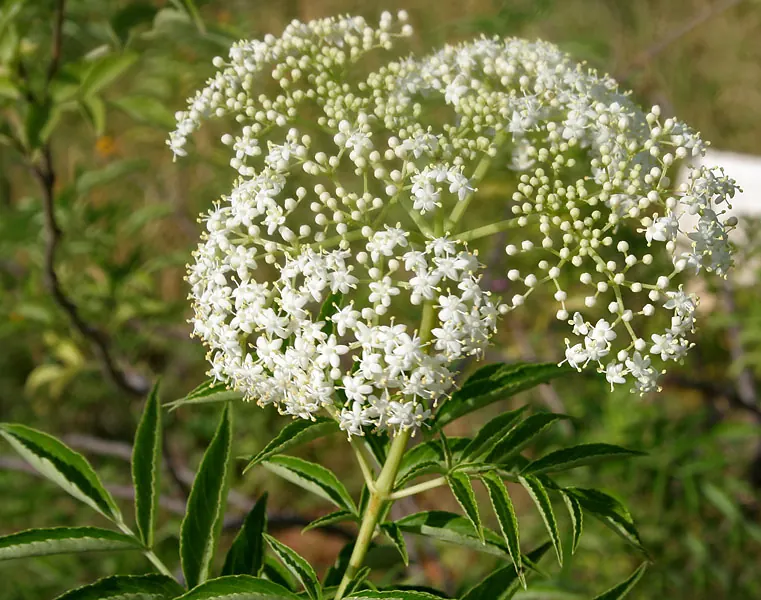
American Elderberry (Sambucus canadensis) in full white-corymb bloom in early summer
Sambucus canadensis — a single flat-topped corymb in early summer. Photo: J.M. Garg (Wikimedia Commons, CC BY-SA).

Identification

[ field key — habit · pith · leaf · flower · fruit ]

Habit & Stems

Multi-stemmed deciduous shrub, usually 6–12 ft tall and nearly as wide, spreading by suckers into open clonal thickets. Canes are fast-growing, weakly woody, and live only 3–5 years before being replaced by new shoots from the crown. The diagnostic ID feature is the spongy white pith filling the center of every stem — snap a young cane and the pith is so soft it can be pushed out with a pencil. The genus name Sambucus comes from sambuce, a Greek wind instrument made by hollowing out elder twigs.

Leaves

Opposite, pinnately compound, 6–12 in long, with 5–11 leaflets (most often 7). Leaflets are lance-shaped to elliptic, 3–5 in long, sharply serrate, bright medium green, with an unpleasant musky odor when crushed. The opposite leaf arrangement combined with the pinnate compound leaf and white pith reliably separates elderberry from sumacs (alternate leaves) and from walnut/hickory (alternate, brown chambered or solid pith).

Flowers

Huge flat-topped cymes (a cymose corymb), 6–10 in across, of hundreds of small creamy-white 5-petaled flowers, each only 5–6 mm wide. Held above the foliage on new wood from late May into early July. The display is unmistakable along Tulsa-area roadside ditches in June. Lightly fragrant; nectar and pollen are accessible to a wide range of short-tongued insects, which is why elderberry inflorescences typically swarm with non-bee pollinators.

Fruit

Drooping cymes of small purple-black drupes, each only 3–5 mm in diameter, hanging in heavy umbrella-inverted clusters that pull the pencil-thin stems down. Each drupe contains 3–5 small stony seeds. Ripens mid-August through mid-September in NE Oklahoma. Unripe red berries are toxic — wait for full purple-black color, then cook (see warning below).

Habitat & Range in NE Oklahoma

American Elderberry is abundant and unmistakable across NE Oklahoma once you learn the silhouette. Look for it along the wet edges of any disturbed ground that holds moisture: roadside ditches, fence rows, the sunny edges of riparian woodland along the Arkansas, Verdigris, Bird Creek and Caney rivers, spring seeps in pastures, the margins of farm ponds, and the lower edges of powerline cuts through bottomland forest. It is a classic edge species — full sun, root zone consistently moist, low competition above the canopy.

Native from southern Canada to northern Mexico east of the Rockies, the species tolerates seasonal flooding (it can stand in standing water for weeks during spring), heavy clay, and a wide pH range from 5.5 to 8.0. It does not tolerate dry, droughty sites — in upland NE OK clay without supplemental water it will sulk, leaf-scorch, and produce few fruits. The reclassification of North American elder as Sambucus nigra subsp. canadensis means it shares pollen compatibility with European black elder cultivars; this matters for orchardists picking pollination partners.

Ecology & Wildlife Value

[ pollinators · larval hosts · seed dispersers · trophic role ]

Flower Visitors

Elderberry corymbs are some of the most insect-diverse flower heads you can plant in a Tulsa-area garden. Open, accessible nectar attracts Syrphidae hover flies, soldier beetles (Chauliognathus pensylvanicus), longhorn flower beetles, sweat bees (Halictus, Lasioglossum), small carpenter bees (Ceratina), and bumblebees. Honeybees work the flowers heavily during the early-summer nectar dearth. Pollination is largely supplemental — elderberry is partially self-fertile but yields dramatically more fruit when a second cultivar or wild plant is within ~60 ft.

Lepidoptera & Beetle Hosts

Larval host plant for several moths, including the elder shoot borer (Achatodes zeae) which tunnels pithy canes, the eight-spotted forester moth (Alypia octomaculata), and several cecidomyiid gall midges. The brilliant crimson elderberry borer beetle (Desmocerus palliatus) is an obligate elder specialist whose larvae develop inside the white pith of living canes — finding one in NE OK is a small thrill.

Birds & Mammals

The fruits are eaten by an estimated 50+ bird species, including cedar waxwings, brown thrashers, gray catbirds, mockingbirds, eastern bluebirds, American robins, and several woodpeckers. Foliage is browsed by white-tailed deer (sometimes heavily on young plantings — cage the first 2 years). Seeds pass intact through bird gut and germinate readily, which is why volunteer elderberries appear under perch trees.

Riparian & Soil Function

Suckering root mass and dense fibrous shallow roots make elderberry an excellent stream-bank stabilizer — USDA NRCS recommends it in riparian buffer plantings throughout the central US. Rapid biomass turnover (canes die and refresh on a 3–5 year cycle) deposits a steady stream of organic matter at the base of the plant, building topsoil and feeding fungi. It does not fix nitrogen.

Permaculture role: Layer 4 (shrub) in a 7-layer food forest. Plant on the wet, sunny edge — pond margins, rain-garden overflow, downhill from a swale. Pairs naturally with pawpaw and persimmon on moist bottomland sites, with chokeberry and buttonbush in the same wet niche, and with comfrey or river oats as the herbaceous layer. Plan for the suckering — give it 8–10 ft of room or expect to mow back the runners every spring.

Horticulture & Care

[ planting · water · pollination · pruning · cultivars · pests ]

Site selection & planting

Plant dormant bare-root or 1-gallon stock in late winter to early spring (February–March in Tulsa). Choose the wettest, sunniest spot you have: full sun gives the heaviest fruit set, and consistent soil moisture is the single biggest yield factor. Spacing for a small home orchard is 6 ft within rows by 10 ft between rows; closer if you intend to coppice on a tight cycle, wider for easier harvest access.

Plant at least two cultivars within 60 ft for cross-pollination. American Elderberry is partially self-fertile but yield, drupe size, and cluster size all increase markedly when a second compatible cultivar (or wild plant) is present. The University of Missouri Elderberry Improvement Project specifically recommends pairing two named cultivars per planting block.

The cut-back-hard pruning system

The standard Missouri-style production system, developed by the University of Missouri Elderberry Improvement Project, treats elderberry as a coppice crop:

Notable cultivars (University of Missouri program)

The cultivars below are the workhorses of U.S. domestic elderberry production. All are S. canadensis; they cross-pollinate freely. 'Adams II', 'Bob Gordon' and 'Wyldewood' are the most commonly recommended starting pair for the lower Midwest including NE Oklahoma.

Cultivar Origin Distinguishing feature Notes for Tulsa
'Bob Gordon' U Missouri release (2011) Very large inverted-umbrella clusters; sturdy stems; high yield Top yielder in MU trials; excellent for syrup and juice; heavy bird pressure if uncovered.
'Wyldewood' OK / MO selection Late blooming, very large clusters, high anthocyanin Strong performer in MU trials; good cross-pollinator for 'Bob Gordon'.
'Ranch' Missouri wild selection Compact (~5–6 ft), early ripening, smaller clusters Lower-maintenance; useful for smaller home plantings.
'Adams II' NY (1926), classic East-coast cv Large fruit, mid-season, vigorous The traditional reference cultivar; reliable pollination partner.
'Nova' Canada (1959) Medium clusters, very early, partially self-fertile Pairs well with 'York' for staggered ripening.
'York' NY (1964) Largest individual berries; late-season Bigger fruit makes hand de-stemming easier; classic 'Nova' partner.

Pests & diseases

Companion planting in a food forest

Pairs naturally with: pawpaw (Asimina triloba) and American persimmon (Diospyros virginiana) in the same moist bottomland niche, buttonbush and chokeberry for additional Layer-4 wet-site shrubs, comfrey as a deep-rooted mineral-mining ground layer, and river oats or sedges as the grass component. Use as the windward edge of a swale system to catch and slow overland flow.

Edible & Medicinal Uses

Cooked-only rule. All vegetative parts of American Elderberry — leaves, stems, roots, bark, and unripe (green or red) fruit — contain cyanogenic glycosides and lectins and can cause nausea, vomiting, and diarrhea if eaten raw. The flowers and the fully ripe purple-black berries are edible, but berries should always be cooked before consumption to inactivate residual glycosides and lectins. Never use the pithy stems as skewers, straws or whistles for food — the pith itself is toxic.

Flowers (elderflower)

Harvest the entire corymb on a sunny morning at full bloom; clip with kitchen shears into a paper bag. Strip the tiny flowers from the cyme stems (the green stems are toxic; the petals are not).

Berries

Harvest entire ripe clusters when 90%+ of drupes are deep purple-black. The fastest home de-stemming trick is to freeze the whole clusters overnight, then rake the frozen drupes off the brittle stems with a fork.

Medicinal context

Elderberry preparations — primarily syrups standardized to anthocyanin content — are a large and growing herbal market category, supported by a modest but real evidence base for shortening the duration of upper respiratory infections (several small randomized trials of European S. nigra extract such as Sambucol). The pharmacology centers on cyanidin-3-glucoside and related anthocyanins, which appear to have mild immune-modulatory and antiviral effects in vitro. Evidence remains preliminary; elderberry syrup is a sensible folk remedy, not a substitute for vaccination or medical treatment.

Commercial U.S. elderberry production is now a real small-acre crop, anchored by the University of Missouri Elderberry Improvement Project and the River Hills Harvest grower cooperative. Oklahoma State University Extension has extended this work to OK growers, and several NE OK farms now run small commercial blocks of 'Bob Gordon' and 'Wyldewood' for syrup and juice markets.

Photo Reference

Sambucus canadensis — flowering habit
// Sambucus canadensis — flowering habit
Wikimedia Commons
Sambucus canadensis — foliage & form
// Sambucus canadensis — foliage & form
Wikimedia Commons
Sambucus canadensis — flower detail
// Sambucus canadensis — flower detail
Wikimedia Commons
Sambucus canadensis — in habitat
// Sambucus canadensis — in habitat
Wikimedia Commons
Sambucus canadensis — fruit / seed
// Sambucus canadensis — fruit / seed
Wikimedia Commons

Sources & Further Reading

  • University of Missouri Center for Agroforestry — Elderberry Improvement Project & grower guides: centerforagroforestry.org — elderberry.
  • USDA NRCS PLANTS Database — Sambucus nigra ssp. canadensis: plants.usda.gov/plant-profile/SANIC4.
  • USDA NRCS Plant Guide — American Black Elderberry (PDF, plant materials program).
  • Lady Bird Johnson Wildflower Center — Native Plant Database, Sambucus nigra ssp. canadensis: wildflower.org — SANIC4.
  • Oklahoma State University Extension — Elderberry production in Oklahoma (HLA fact sheets).
  • North Carolina State Extension Plant Toolbox — Sambucus canadensis: plants.ces.ncsu.edu.
  • Wikipedia — Sambucus canadensis: en.wikipedia.org/wiki/Sambucus_canadensis (CC BY-SA 4.0; portions of the description, taxonomy and toxicity sections summarize Wikipedia content).
  • Tiralongo E. et al. (2016), Elderberry supplementation reduces cold duration and symptoms in air-travellers, Nutrients 8(4):182 — representative clinical trial.

Photos courtesy of Wikimedia Commons contributors under their respective licenses (linked under each image).