home/ plants/ maidenhair-fern

// SPECIES PROFILE · FERN · NATIVE

Northern Maidenhair Fern

Adiantum pedatum

The Northern Maidenhair is the most architecturally distinctive fern of the eastern North American woodland flora. A slender, shiny jet-black petiole rises 12–24 in from a creeping rhizome and then forks at the top into a horseshoe-shaped fan of arching pinnae — so that the entire frond, viewed from above, appears almost perfectly circular. This pedate architecture (Latin pedatum, "like a foot") is diagnostic and unmistakable. In NE Oklahoma it is uncommon and quietly significant: where you find a colony of Adiantum pedatum, you are standing in a piece of intact, mesic Ozark or Cookson Hills woodland that has been left undisturbed for a long time.

// QUICK FACTS
Family
Pteridaceae (maidenhair fern family)
Native range
E. North America: Nova Scotia → Georgia, west to E. Oklahoma & the Pacific NW disjunct
NE Oklahoma habitat
Moist deciduous ravines, north slopes, sandstone & limestone bluffs of the Ozarks & Cookson Hills
USDA hardiness
Zones 3–8 (Tulsa = 7a/7b)
Mature size
12–24 in tall · slowly clumping by short rhizomes
Growth rate
Slow; takes 2–3 yrs to look like a "real" plant
Lifespan
Long-lived clumps; decades if undisturbed
Habit
Deciduous fern; fronds emerge as pink-bronze croziers in mid-spring
Sun
Full shade → part shade (no direct afternoon sun)
Soil
Moist, humus-rich, well-drained loam; pH 6.0–7.5 (tolerates limestone)
Water
Consistently moist — never allowed to dry
Wildlife
Cover for amphibians & ground-nesting birds; spores wind-dispersed
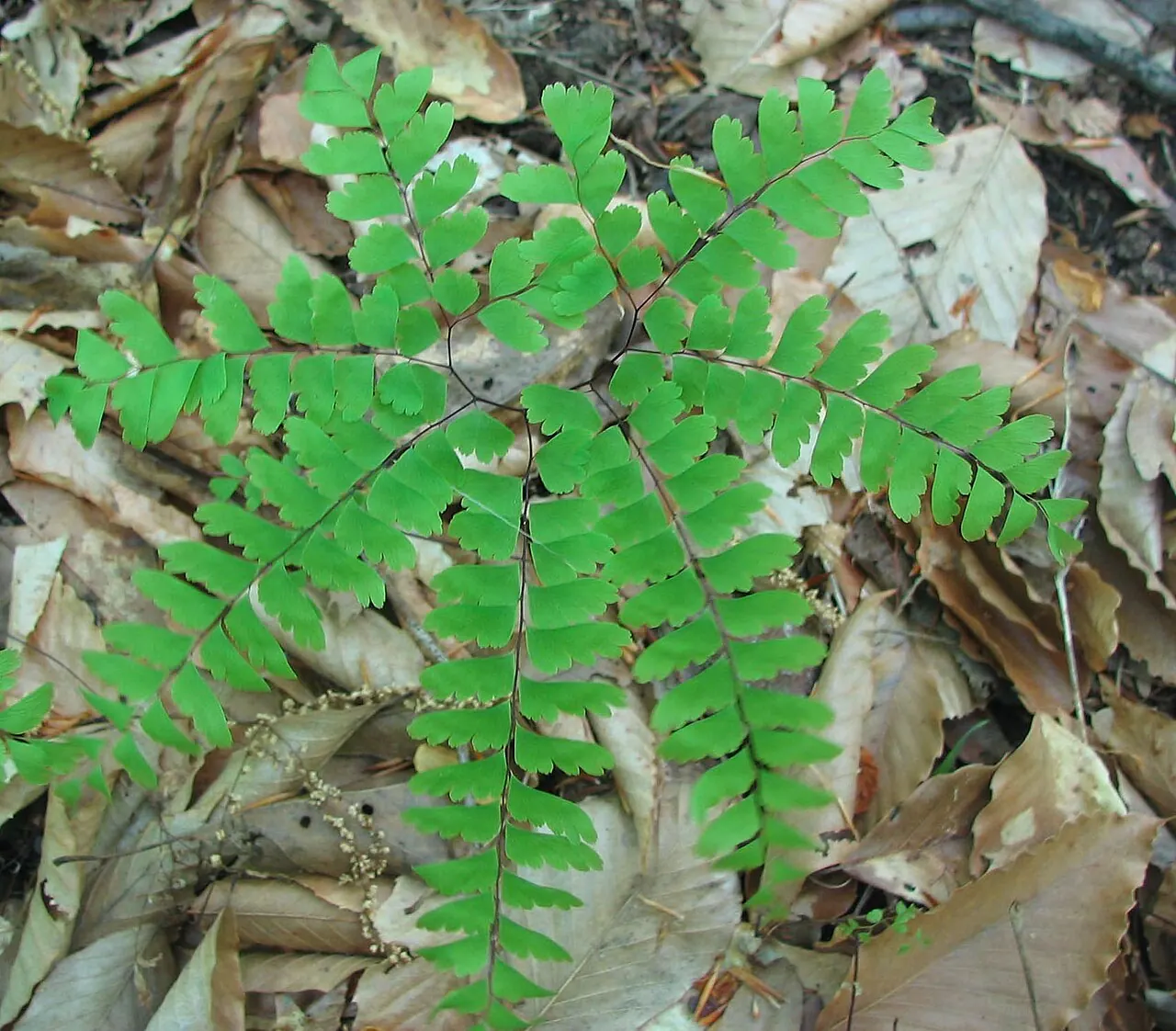
Adiantum pedatum viewed from above showing the diagnostic horseshoe-shaped pedate frond
Adiantum pedatum from above — the forked petiole and horseshoe arrangement of pinnae produce the near-circular “pedate” frond that names the species. Photo: Wikimedia Commons (file page).

Identification

[ field key — petiole · frond architecture · pinnules · sori ]

Petiole (Stipe)

The single most striking feature: a slender, wiry, shiny jet-black to deep purple-brown petiole, 15–40 cm long, smooth and almost polished-looking, rising vertically from the rhizome. Near the top it forks once into two equal curving branches that together sweep outward to form a U or horseshoe. The black petiole color persists along the rachises, throwing the pale-green pinnules into striking contrast.

Frond Architecture

From the forked petiole, 5–9 finger-like pinnae radiate outward along the inside of the horseshoe — hence the common name "five-finger fern." Each pinna is itself once-pinnate. Viewed straight down from above, the assembled frond appears as a nearly circular fan, 20–40 cm across, held parallel to the ground. No other fern in the eastern U.S. flora has this geometry; once you have seen it you will never misidentify it.

Pinnules

Pinnules are small, delicate, light bright-green, asymmetrically oblong (~1–2 cm long), with the upper margin shallowly lobed and the lower margin straight where it meets the rachis. The blade is thin and translucent, and the surface is famously water-repellent — rain beads up and rolls off, the property that gave the genus its name (Greek adiantos, "unwetted"). Fronds emerge in late April as pink-bronze, tightly coiled croziers (fiddleheads).

Sori & Reproduction

Maidenhair ferns lack a true indusium. Instead, sori (clusters of sporangia) are borne along the upper margin of fertile pinnules and are protected by a false indusium — the pinnule edge itself folds back over them like a tiny hem. Visible mid-summer through early fall as oblong dark stripes along the pinnule rim. Spores are wind-dispersed; in cultivation a colony spreads chiefly by the slow creep of its short, branching rhizome.

Habitat & Range in NE Oklahoma

Across its broad eastern North American range, Adiantum pedatum is a specialist of cool, moist, deciduous woodland: rich mesic forest ravines, north-facing slopes, the foot of seeping limestone and sandstone bluffs, shaded streamsides, and the bouldered understory of old hemlock–hardwood stands. It needs deep humus, neutral to slightly acidic soils that stay reliably moist through summer, and protection from direct afternoon sun and drying wind.

In Oklahoma it sits at the dry-edge of its range and is consequently uncommon and locally restricted — almost entirely confined to the eastern third of the state. Look for it in the Oklahoma Ozarks (Adair, Cherokee, Delaware, Sequoyah counties), the Cookson Hills sandstone ravines, shaded coves along the Illinois and Arkansas rivers, and isolated mesic pockets on the Boston Mountains escarpment. It is essentially absent from the central and western parts of the state, where summer heat, wind and drought make conditions intolerable.

Indicator species: A wild colony of Adiantum pedatum in NE Oklahoma is a reliable indicator of an intact, undisturbed mesic woodland with decades of accumulated leaf-litter and reliable subsurface moisture — the kind of site that does not regenerate within a human lifetime once cleared. If you find a wild population, leave it in place. Do not dig. Source nursery-propagated plants for your garden instead.

Ecology & Wildlife Value

[ herbivory · habitat structure · spore dispersal · indicator role ]

Herbivory

Like most ferns, Adiantum pedatum is not a major herbivore food. White-tailed deer and Eastern cottontail rabbits will browse fronds occasionally but generally pass it over in favor of angiosperms. Few specific insect associates have been recorded; ferns produce relatively few palatable secondary chemistries that target Lepidoptera larvae the way woody plants do.

Habitat Structure

The dense, low canopy of a mature maidenhair colony produces cool, humid microhabitat at ground level — valuable cover for woodland salamanders (incl. the slimy and Western slimy salamanders of the Ozarks), small snakes, ground-nesting songbirds such as ovenbirds and worm-eating warblers, and a host of woodland invertebrates that rely on persistently damp leaf-litter.

Spores & Dispersal

Spores released from the false-indusium-protected sori are wind-dispersed in late summer and require a moist, shaded surface to germinate into the free-living gametophyte (prothallus) generation. Successful establishment from spore is rare in the wild and slow — another reason mature colonies are so significant. In the garden, vegetative rhizome spread is by far the more reliable mode of increase.

Indicator of Forest Integrity

Across eastern North America, ecologists treat Adiantum pedatum as a symbol and proxy of intact mesic forest understory: its presence indicates undisturbed soil, stable hydrology, deep leaf-litter, and an absence of recent grazing, fire or logging. The plant is slow to colonize, slow to recover from disturbance, and intolerant of drying — so where you see it, you are looking at a piece of woodland that has been left alone.

Permaculture role: Layer 6 (groundcover / herbaceous shade stratum) in a 7-layer food forest. Plant beneath the deepest shade of mature oaks, hickories, sycamores or sugar maples in a guild with native Heuchera americana, Christmas fern (Polystichum acrostichoides), wild ginger (Asarum canadense) and native columbine (Aquilegia canadensis) for a complete deep-shade understory mosaic.

Horticulture & Care

[ siting · soil · water · propagation · pruning · pests ]

Site selection & planting

Choose the coolest, shadiest, most reliably moist part of your garden — a north or east exposure under mature deciduous canopy, ideally with no direct afternoon sun at any time of year. Maidenhair will tolerate dappled morning sun but scorches and collapses under western OK afternoon sun. Soil must be a deep, friable, humus-rich loam with consistent sub-surface moisture and excellent drainage — standing water rots the rhizome. pH range 6.0–7.5; tolerates limestone-derived soils despite a mild preference for slightly acidic conditions.

Water & soil after establishment

Even mature plants are not drought-tolerant. During NE Oklahoma's mid-summer dry spells (late July through early September) supplemental water is usually required — aim to keep the root zone evenly moist, never sopping and never bone-dry. An annual top-dress of leaf-mold each fall maintains the humus layer the rhizomes ride on. No fertilizer is required in soil that receives this treatment; chemical fertilizers can burn the fine roots.

Pruning & clean-up

Cut spent fronds back to the ground in late winter just before new croziers emerge. Do not disturb established clumps — maidenhair resents transplanting and root disturbance, and a happy colony left in peace will slowly expand for decades. Avoid cultivating, walking on, or stacking heavy mulch over the rhizome zone.

Propagation

Container culture

Maidenhair grows well in shaded containers provided the medium is kept consistently cool and moist. Use a wide, shallow pot (the rhizome runs laterally), a peat-free humus-rich potting mix, and place the container in deep shade. Move under cover in extreme summer heat; protect from drying winter winds. A double-pot arrangement (pot inside a slightly larger pot, gap stuffed with damp sphagnum) buffers temperature and moisture swings.

Pests & diseases

Related species & cultivars for the Tulsa region

Taxon / Cultivar Type Distinguishing feature Notes for NE Oklahoma
Adiantum pedatum (straight species) Native fern Pedate, horseshoe-shaped frond on a black petiole; 12–24 in tall The native of Ozark/Cookson Hills mesic woodland; the only form to plant for restoration.
Adiantum capillus-veneris (Southern maidenhair) Native fern Smaller, lacy, drooping fronds (not pedate); finely divided; black petiole Native to OK at Roman Nose State Park seeping limestone ledges and a few scattered locales; needs more moisture and tolerates higher pH than A. pedatum; specialist of dripping calcareous rock.
Adiantum pedatum 'Imbricatum' Cultivar Dwarf, ~6–10 in; overlapping pinnules, denser texture Small-space shade gardens; same care as the species.
Adiantum aleuticum (Western maidenhair) Sister species Long-segregated from A. pedatum; western N. America Not native to OK; sometimes sold interchangeably. Stick with the eastern species locally.
Adiantum venustum (Himalayan maidenhair) Non-native ornamental Evergreen, low groundcover-forming, fronds 6–9 in A useful evergreen shade groundcover, but not a substitute for the native species in habitat plantings.

Companion planting in a native shade garden

Pairs naturally with: native Heuchera americana and H. villosa, Christmas fern (Polystichum acrostichoides), wild ginger (Asarum canadense), native columbine (Aquilegia canadensis), Solomon's seal (Polygonatum biflorum), and woodland phlox (Phlox divaricata). For a complete NE Oklahoma shade-garden mosaic, layer maidenhair beneath an upper canopy of native chinkapin oak, sugar maple or shagbark hickory, with a midstory of Cercis canadensis, dogwood, or pawpaw.
Cultural & Medicinal Uses

Despite its delicate appearance, Adiantum pedatum has a long human history across both Indigenous North American and European herbal traditions:

Caution: Maidenhair fern requires consistent moisture. It is not a drought-tolerant or low-water plant and will collapse irreversibly within a single hot, dry week if its root zone is allowed to dry out. Do not plant it in a site you cannot reliably water through August. Medicinal use of the rhizome should only be undertaken under the guidance of a qualified herbalist; some Adiantum species contain compounds that are not safe in quantity.

Photo Reference

A patch (colony) of Adiantum pedatum showing the slow rhizomatous spread habit
// Colony habit · slowly rhizomatous · 12–24 in tall
Wikimedia Commons
Close-up of an Adiantum pedatum frond showing forking black petiole and radiating pinnae
// Forking black petiole · pedate frond · radiating pinnae
Wikimedia Commons
Pinnules of Adiantum pedatum viewed from below against the sky
// Pinnule detail · light translucent green · water-repellent surface
Wikimedia Commons
Adiantum pedatum in its native moist deciduous woodland habitat
// Native woodland habitat · USFWS field photo
Wikimedia Commons

Sources & Further Reading

Photos courtesy of Wikimedia Commons contributors under their respective licenses (linked under each image). Hero photo from Wikimedia Commons.