// SPECIES PROFILE · TREE · NATIVE · NUANCED
Both an essential native and the most aggressive woody invader of unburned NE Oklahoma grasslands, the Eastern Redcedar is the small evergreen juniper that defines old fields, fence rows and prairie edges from the Cross Timbers north to the Flint Hills. A long-lived dioecious conifer with shreddy reddish bark and glaucous-blue fleshy female cones, it is dispersed by cedar waxwings, hosts the juniper hairstreak butterfly, and — in the absence of fire — converts open prairie into closed cedar woodland in a few decades. Treat it as an indispensable wildlife tree on the right site, and as a management problem on the wrong one.

[ field key — bark · foliage (juvenile vs adult) · cones · habit ]
Slow-growing evergreen conifer, typically 30–50 ft in NE Oklahoma with a single short trunk 12–39 in diameter and a dense conical to subcylindrical (columnar) crown that broadens and becomes irregular with age. Bark is the diagnostic giveaway: reddish-brown, fibrous, peeling off in long narrow vertical strips. The wood beneath is aromatic, with pale yellowish sapwood and a striking pinkish-red heartwood — the source of every "cedar chest" and "cedar closet" in the eastern US.
Two leaf forms, often on the same tree, are the single most reliable ID feature:
Juvenile foliage dominates plants under three years old and persists as scattered shoots inside shaded portions of mature crowns. This dual foliage distinguishes J. virginiana from look-alike Ashe juniper (J. ashei) of the SW Oklahoma cedar brakes.
Eastern Redcedar is dioecious: male and female cones grow on separate trees. The familiar blue "berries" are actually fleshy female seed cones 3–7 mm across, dark purple-blue under a heavy white wax that gives them a pale sky-blue cast when ripe (Sept–Nov). Each contains 1–3 wingless seeds. Male pollen cones are smaller (2–3 mm), tan-yellow, and release the notorious clouds of allergenic pollen in late winter — if you've ever walked past a yellow-tipped redcedar in a February breeze and watched it smoke, that's a male tree.
Often confused with Juniperus ashei (Ashe juniper, "mountain cedar" of the Arbuckles and Edwards Plateau) which is multi-stemmed and has a broader crown; with J. scopulorum (Rocky Mountain juniper) further west; and with planted Thuja occidentalis (eastern white cedar) which has flat sprays of foliage and dry woody cones. J. virginiana is the only native juniper across nearly all of NE Oklahoma.
Juniperus virginiana is a textbook pioneer species — unusually long-lived for a pioneer — that colonizes disturbed open ground faster than almost any other tree in the region. Across NE Oklahoma you find it on limestone-derived soils of the western Ozarks, sandstone ridges of the Cross Timbers, abandoned pastures and old fields throughout the Tulsa, Pawhuska and Bartlesville corridor, fence rows wherever birds perch, riparian terraces along the Verdigris and Caney rivers, and increasingly throughout what was historically tallgrass prairie. It tolerates the full range of regional soils — rocky chert ridges, deep alluvial bottoms, compacted urban clay, and the alkaline limestone outcrops of Osage County — and is conspicuously absent only from deep shade under closed hardwood canopy, where its seedlings cannot recruit.
Critically, redcedar is fire-intolerant: low branches near the ground catch easily and a single low-intensity grass fire historically killed seedlings outright. Pre-settlement tallgrass prairie burned every 1–5 years from lightning and Indigenous burning, holding redcedar to scattered fire-refugia on rocky bluffs and creek breaks. Post-settlement fire suppression, plus dispersal by cedar waxwings perching on barbed-wire fences, has produced what NE Oklahoma ranchers and ecologists now call the "green glacier" — a steady, decade-by-decade conversion of open prairie into closed cedar woodland. Oklahoma State University Extension and the Noble Research Institute (Ardmore) have documented this as the most economically and ecologically significant woody encroachment problem in the state, with measurable losses in forage production, watershed yield, grassland-bird habitat, and small-mammal diversity once cedar canopy cover exceeds roughly 10–30%.
[ frugivory · larval hosts · cover · cedar-apple rust · encroachment ]
The fleshy female cones are winter-persistent and one of the most important cold-season fruit crops in the region. Cedar waxwings, American robins, Northern mockingbirds, Eastern bluebirds, yellow-rumped warblers, wild turkeys and bobwhite quail all feed heavily; mammal dispersers include foxes, raccoons, opossums, and coyotes. Cedar waxwing gut passage roughly triples seed germination rates versus uneaten seeds — this is the species' primary dispersal vector and the reason cedars line every fence row and powerline.
Dense evergreen foliage gives Eastern Redcedar exceptional value as winter thermal cover and year-round nesting habitat. Over 50 bird species are documented to nest, roost, or shelter in it, including chipping sparrow, mourning dove, mockingbird, brown thrasher, and (notably in NE Oklahoma) the long-eared owl in winter. White-tailed deer use thick cedar stands as bedding cover during cold fronts.
Sole larval host plant of the juniper hairstreak butterfly (Callophrys gryneus) — a small iridescent green hairstreak whose entire life cycle in our region depends on this tree. Also the primary host of the bagworm moth (Thyridopteryx ephemeraeformis) — a feature, not a bug, unless you're growing it as a sheared specimen. Numerous other moths and leafhoppers feed on it.
J. virginiana is the obligate alternate host for Gymnosporangium juniperi-virginianae — cedar-apple rust — and its relatives that affect serviceberry and hawthorn. The fungus produces brown woody galls on cedar twigs that, in spring rains, swell into bright orange gelatinous "horns" releasing spores that travel up to a mile to infect apple, crabapple, hawthorn and serviceberry foliage and fruit. The disease cycle requires both hosts to complete — managing one host breaks the cycle.
[ planting · siting · cultivars · pruning · windbreaks · management ]
Choose Eastern Redcedar deliberately, in the right place, for the right job. It is an outstanding plant for: windbreaks and shelterbelts (the backbone of the 1930s Prairie States Forest Project), wildlife thickets on rural property, evergreen privacy screens on dry tough sites where Leyland cypress will fail, erosion control on rocky slopes, and as a specimen tree in a meadow or naturalistic landscape. Do not plant it in or adjacent to remnant prairie, in or near home orchards, or as a casual sheared hedge plant where bagworm management will become a chore.
Eastern Redcedar tolerates light shaping but does not regenerate readily from old wood — do not shear into bare interior branches. Remove dead or damaged limbs anytime; prune for form in late winter. Watch for bagworm bags in late summer and hand-pick before larvae emerge the following spring.
| Cultivar | Sex / habit | Distinguishing feature | Notes for Tulsa |
|---|---|---|---|
| 'Canaertii' | Female · narrow conical | Heavy crop of glaucous-blue cones, dark green foliage | Classic ornamental selection — superb wildlife tree but the cone crop makes it a strong cedar-apple rust source. |
| 'Burkii' | Female · narrow pyramidal | Steel-blue summer foliage turning purple-bronze in winter | Reliable accent tree; same orchard-distance caveat as 'Canaertii'. |
| 'Taylor' | Female · strictly columnar | Very narrow upright form like Italian cypress, 15–20 ft × 3 ft | Plains-bred (Nebraska); the regional substitute for Mediterranean cypress in formal landscapes. Hardy and drought-proof. |
| 'Grey Owl' | Female · low spreading | Wide, low silver-gray mound, 3 ft × 6 ft | Foundation / mass-planting groundcover form; tough on dry banks. |
| 'Corcorcor' (Emerald Sentinel®) | Female · dense erect crown | Glossy emerald-green foliage, prolific blue cones | Modern improvement on 'Canaertii'; dense uniform habit. |
| 'Goldspire' | Narrow conical | Gold-tipped foliage, narrow upright form | Specimen tree; full sun for best color. |
| 'Kobold' | Dwarf · rounded | Compact 3–4 ft mound | Rock garden / small-space conifer. |
Note: 'Skyrocket', often sold as a redcedar cultivar at big-box garden centers, is actually a cultivar of the western Juniperus scopulorum (Rocky Mountain juniper) and is less reliably hardy in our humid summers.
For functional NE Oklahoma windbreaks, plant 2–3 staggered rows of seedling redcedar at 8–10 ft on-center, perpendicular to prevailing winter NW winds, ideally combined with an outer row of a deciduous species (Osage-orange, bur oak, or chickasaw plum) for layered structure. Established shelterbelts measurably reduce wind speed for a downwind distance of roughly 10x the mature tree height — a major factor in livestock survival, soil retention, and home heating costs across the open country north and west of Tulsa.
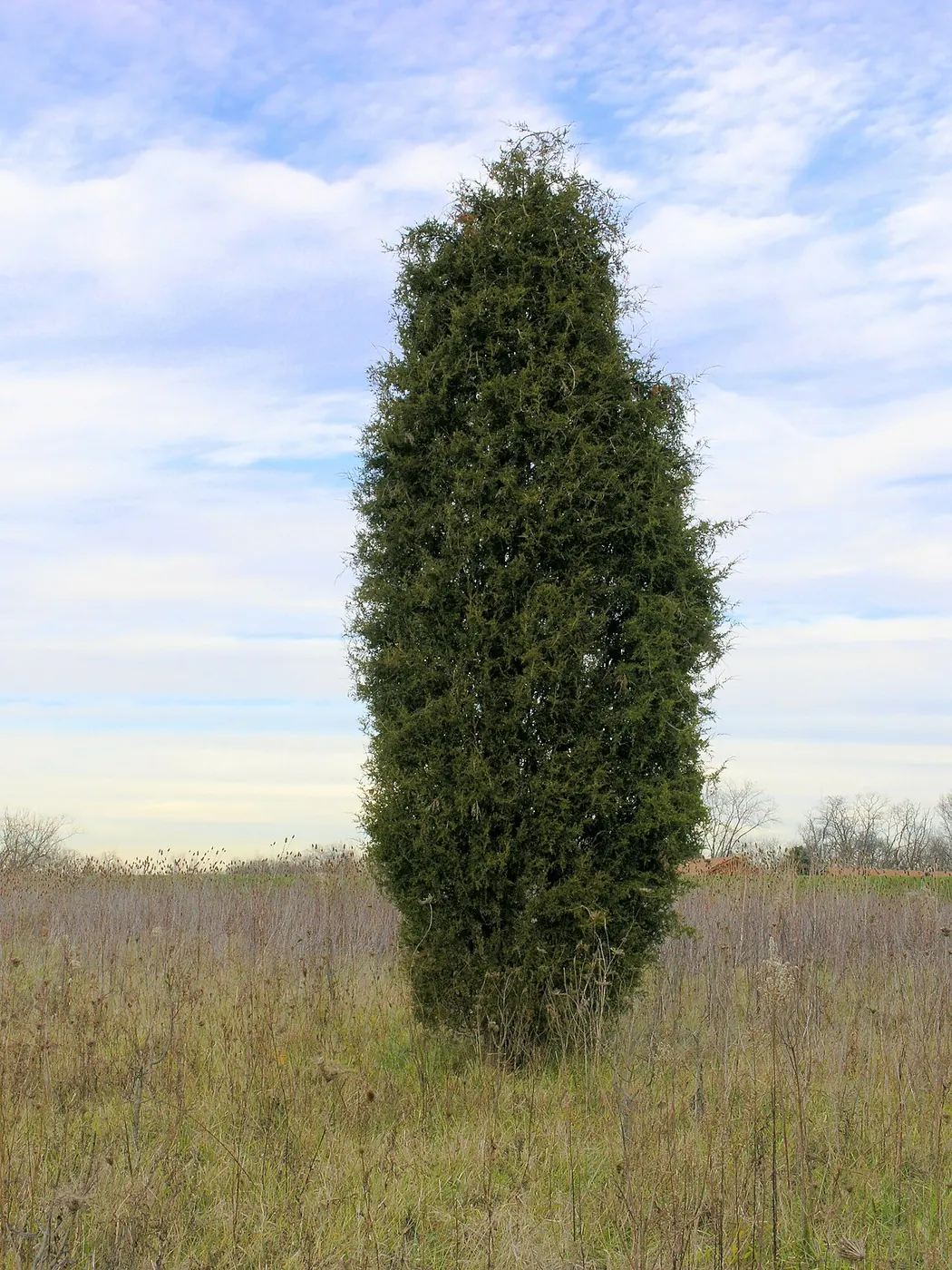
Few American trees have as long or as broad a utilitarian record as Eastern Redcedar, and almost all of it ties back to the same remarkable property: its aromatic, lightweight, rot-resistant pinkish-red heartwood.


Photos courtesy of Wikimedia Commons contributors under their respective licenses (linked under each image).
[ guild · polyculture · cross-layer pairings ]
In a Cross Timbers oak-hickory savanna, eastern redcedar pairs naturally with: chickasaw plum (Prunus angustifolia), crossvine (Bignonia capreolata), osage orange (Maclura pomifera), fragrant sumac (Rhus aromatica), maypop / passionflower (Passiflora incarnata), and american persimmon (Diospyros virginiana).
eastern redcedar works best as a canopy or sub-canopy partner above the herbaceous and shrub layers.